The year 2026 marks a watershed moment in consumer and enterprise technology. We have officially transitioned from the era of software-only artificial intelligence into the age of embodied intelligence, spatial computing, next-generation silicon, and clean mobility. If you are tracking tech being released 2026, you already know that this year is packed with hardware breakthroughs that previously sounded like science fiction.
At BuzzTechy, our editorial team has compiled the definitive, verified breakdown of the most anticipated consumer electronics, AI computing hardware, smart wearables, and industrial robotics hitting shelves and enterprise markets throughout 2026. Here is everything hitting the market this year, when you can get it, and what it means for your daily life and career.
2026 Tech Release Roadmap: What?s Coming by Quarter
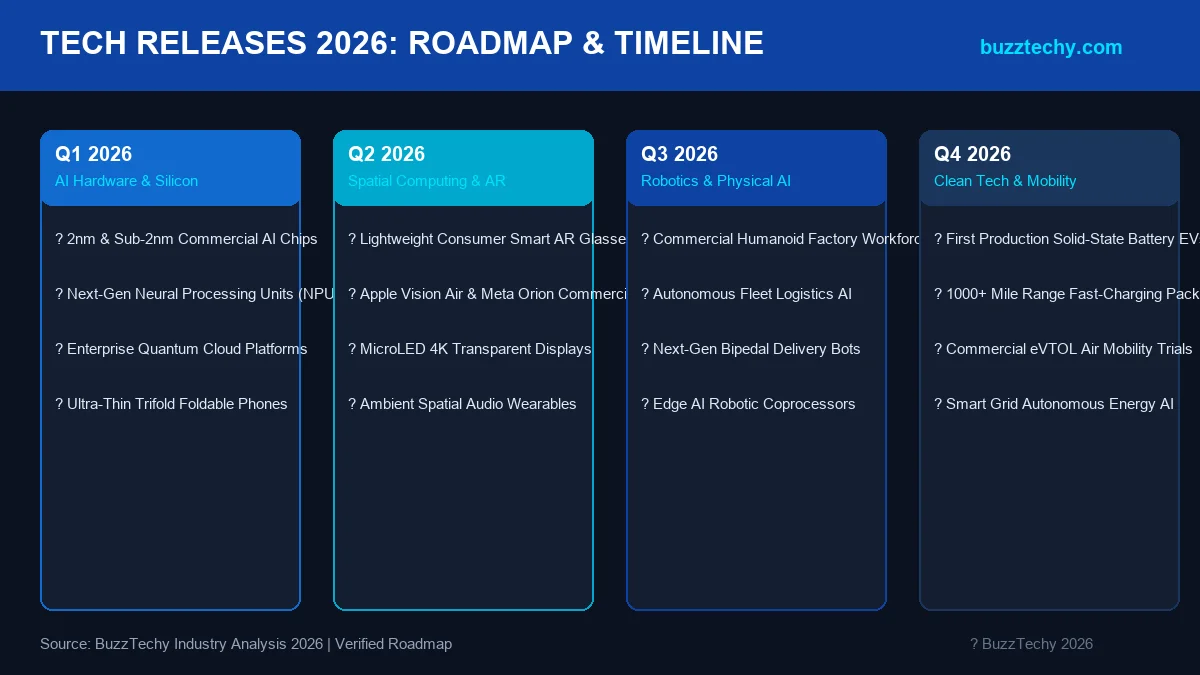
To give you a structured overview of the year’s hardware timeline, here is the master roadmap breaking down the biggest rollouts across consumer tech, computing hardware, and smart mobility:
| Quarter | Core Category | Flagship Tech Being Released | Market Target |
|---|---|---|---|
| Q1 2026 | Silicon & Computing | 2nm AI Accelerators, Tri-Fold Foldables, Quantum Cloud SDKs | Early Adopters & Devs |
| Q2 2026 | Spatial Tech & Wearables | Consumer AR Smart Glasses, MicroLED Transparent Monitors | Consumers & Creators |
| Q3 2026 | Robotics & Physical AI | Commercial Bipedal Humanoids, Autonomous Logistics Drones | Enterprise & Supply Chain |
| Q4 2026 | Clean Mobility & Energy | Solid-State EV Battery Packs, Commercial eVTOL Shuttles | Automotive & Fleet |
1. Consumer Gadgets: Foldables, Trifolds & Transparent Screens
Smartphone innovation has shifted into third gear with the commercial normalization of multi-fold architectures and revolutionary display technologies. Here are the core consumer gadgets landing this year:
Next-Gen Dual-Hinge Trifold Smartphones
Following Huawei’s early commercial proof-of-concept, 2026 brings global mass-market trifold smartphones from multiple manufacturers including Samsung and Honor. These devices feature dual-hinge mechanisms that fold out into a full 10.2-inch ultra-thin OLED workspace while folding back down into a pocket-friendly 12mm thick everyday handset. Coupled with localized on-device AI coprocessors, they effectively replace both laptops and tablets for mobile professionals.
MicroLED Gaming & Creator Monitors
While MicroLED previously remained restricted to six-figure commercial video walls, 2026 introduces the first commercially viable 32-inch and 49-inch MicroLED desktop panels. Offering individual sub-pixel illumination without OLED’s risk of burn-in, 5000-nit peak HDR brightness, and 0.01ms response times, this technology is redefining visual workflows for content creators using advanced text to video AI tools and visual design engines.
2. Spatial Computing: Lightweight AR Glasses Replace Bulky Headsets
Heavy, isolating VR goggles are making way for everyday smart glasses with discrete micro-projectors. The major theme of 2026 spatial technology is form factor miniaturization:
- Consumer-Grade Waveguide AR: Weighing under 75 grams, new smart glasses from Meta, Ray-Ban partnerships, and Apple-aligned supply chains project real-time navigation, live language translation, and heads-up AI visual prompts directly into your peripheral field of vision.
- Electrochemical Prescription Displays: Next-gen lenses seamlessly switch between sunglasses tinting and optical clarity while providing real-time biometric HUDs without visible front-facing camera cutouts.
- Neural Wristband Inputs: Surface electromyography (sEMG) wrist sensors now detect micro-finger gestures (pinch, swipe, tap) to control spatial interfaces without needing exaggerated hand gestures in public.
3. AI Hardware & Silicon: The 2nm Architecture Revolution
On the semiconductor front, 2026 is the year foundry giants TSMC, Intel, and Samsung scale sub-2nm Gate-All-Around (GAA) silicon into commercial shipments. This powers an entirely new class of personal computing hardware and AI acceleration:
| Hardware Component | Technological Leap in 2026 | Direct Practical Benefit |
|---|---|---|
| Desktop NPUs | Over 100 TOPS (Tera Operations Per Second) standard | Run 30B+ parameter local LLMs offline without GPU bottleneck |
| High-Bandwidth Memory (HBM4) | Over 2 TB/s memory throughput per socket | Eliminates memory starvation in multi-agent autonomous coding systems |
| Neuromorphic Coprocessors | Event-based spike timing architecture | Ultra-low power biometric and voice processing on wearables |
For developers and data scientists building with open source AI models, this hardware shift means you no longer require expensive cloud API clusters for mid-sized inferencing. You can run complex reasoning stacks directly on personal desktop rigs. Check our detailed guide on local LLM hardware requirements for complete build specifications.
4. Physical AI & Robotics: Commercial Humanoids in the Wild
2026 is officially the commercial deployment year for general-purpose bipedal humanoid robots. Companies like Figure (Figure 02), Boston Dynamics (electric Atlas), and Tesla (Optimus Gen 3) are moving from laboratory pilots into active factory and logistics deployments:
- Automotive Assembly Deployment: Major automotive manufacturing facilities in Germany, Japan, and the United States have integrated humanoid platforms for repetitive tote-handling, sheet metal inspection, and precision screw fastening.
- Vision-Language-Action (VLA) Models: Unlike rigid robotic arms programmed with static coordinates, 2026 humanoids use end-to-end neural networks that interpret natural speech instructions, adapt to dropped objects, and correct their own errors in real time.
- Tactile Dexterous Hands: New sensor-dense robotic hands feature multi-axis force sensing and silicone fingertips capable of safely handling fragile glassware, wiring harnesses, and microchips.
5. Clean Mobility: Solid-State Battery Electric Vehicles
In electric mobility, 2026 delivers the long-awaited entry of solid-state battery (SSB) commercial pilot vehicles. Automotive innovators including Toyota, QuantumScape partners, and European luxury marques are debuting vehicles that redefine the EV experience:
- 10-Minute Full Charging: Solid electrolytes eliminate the dendritic short-circuit risks of liquid lithium batteries, enabling 10% to 80% charging in under 10 minutes at 500kW DC stations.
- 600+ Miles (1000 km) Real-World Range: Volumetric energy densities exceeding 450 Wh/kg allow smaller, lighter battery packs that deliver unprecedented cross-country highway endurance.
- Zero Thermal Runaway: Non-flammable solid materials virtually eliminate battery fire risks, significantly lowering vehicle insurance rates and maintenance overhead.
2025 vs. 2026: How the Tech Landscape Has Evolved
| Technology Area | Where Tech Stood in 2025 | What’s Being Released in 2026 |
|---|---|---|
| Artificial Intelligence | Cloud-heavy prompt-and-response chatbots | Autonomous local agent swarms with physical robotics integration |
| XR / Wearables | Heavy VR headsets with passthrough cameras | All-day lightweight optical waveguide AR smart glasses |
| Mobile Hardware | Standard dual-screen book-style foldables | Ultra-slim trifold form factors with dynamic 3-screen workspaces |
| Software Development | Assisted code completions & autocomplete | Full-stack autonomous multi-agent engineering workflows via AI coding assistants |
| EV Batteries | Liquid electrolyte Lithium-Ion / LFP | First commercial solid-state packs with 10-minute fast charging |
Frequently Asked Questions (FAQ)
What is the most anticipated piece of tech being released in 2026?
The most anticipated consumer tech release is lightweight, all-day consumer AR smart glasses from major tech giants, alongside commercial solid-state battery electric vehicles with 10-minute ultra-fast charging capabilities.
Will consumer trifold smartphones be available globally in 2026?
Yes. Following regional introductions in late 2024 and 2025, multiple manufacturers are launching global editions of trifold smartphones in 2026 with international warranty coverage, multilingual software, and carrier support.
Can I run modern 2026 AI models locally on my home PC?
With 2026’s desktop processors featuring 100+ TOPS NPUs and high-bandwidth unified memory architectures, running 30B to 70B parameter models locally on laptops and desktops without cloud subscription fees is now fully practical.
Are humanoid robots safe to work alongside human employees?
Commercial humanoid robots released in 2026 comply with ISO safety regulations for collaborative robotics. They feature force-feedback torque sensors, redundant emergency stop protocols, and vision-based predictive collision avoidance to ensure safe workplace collaboration.
The BuzzTechy Verdict: How to Prepare for 2026 Tech
The wave of tech being released in 2026 represents tangible, practical progress rather than empty concept showcases. Whether you are an everyday consumer planning your next smartphone upgrade, a developer leveraging modern AI productivity tools, or an enterprise leader evaluating automated manufacturing robotics, this year offers transformative hardware investments.
Stay tuned to BuzzTechy as our review team gets hands-on with every major release, benchmark, and real-world teardown throughout 2026. Bookmark our site and join the discussion in the comments below: Which 2026 tech release are you most excited to get your hands on?